How Paint Protection Film Responds to Temperature Fluctuations and UV Radiation
Your car’s paint doesn’t just face dirt and grime — it’s constantly tested by the world around it. From blazing summer heat to freezing winter mornings, the surface of your vehicle expands, contracts, and reacts to every degree of temperature change. That’s where paint protection film comes in — not just as a clear wrap but as an advanced material designed to adapt intelligently to environmental stress.
At Capital Wrappers, understanding how paint protection film behaves under temperature fluctuations and UV radiation is more than surface-level science. It’s about exploring how polymer chemistry, thermal elasticity, and molecular stability combine to protect vehicle finishes in real-world conditions — whether that’s a hot parking lot or a snow-covered street.
Why Understanding Environmental Impact on PPF Matters
The environment is your car’s biggest test chamber. When temperatures swing wildly or sunlight beams down for hours, even the toughest paint layers can break down. Knowing how PPF responds under those conditions helps us understand why it’s not just a cosmetic barrier but a material engineered for survival.
How Modern Automotive Materials Adapt to Harsh Conditions
Automotive surfaces today are made to flex, not fracture. Much like your skin adapts to changing weather, paint protection film adjusts to temperature changes through its unique composition — expanding slightly under heat and contracting under cold while maintaining its grip on the paint.
The Composition of Paint Protection Film
The Science Behind Thermoplastic Urethane (TPU)
At its core, paint protection film is made from thermoplastic urethane, or TPU. This material combines elasticity with toughness — think of it like a rubberized shield that bounces back from small impacts. TPU’s molecular chains stretch under heat and compress when cooled, giving it remarkable resilience against physical and thermal stress.
Layered Design and Molecular Purpose
A high-quality PPF includes multiple layers: a self-healing top coat, an elastic middle core, and a pressure-sensitive adhesive base. Each layer serves a distinct function — the top fights scratches, the middle absorbs impact, and the base ensures long-term adhesion. This layered design gives the film its signature flexibility and strength.
The Relationship Between Heat and PPF Performance
Thermal Expansion and Contraction in Automotive Surfaces
When metal or paint heats up, it expands microscopically. When it cools down, it contracts. Over time, these cycles can cause clear coats to crack or lose adhesion. Without protection, these small changes lead to visible damage such as fading, peeling, or blistering.
How PPF Adjusts to Rapid Temperature Changes
Paint Protection Film Rockville works like a buffer. It absorbs these temperature swings by stretching and contracting along with the vehicle’s panels. Its molecular structure prevents tearing or bubbling, allowing it to remain stable even when the underlying paint shifts due to heat or cold.
Maintaining Adhesion During Extreme Heat
In regions where temperatures soar, maintaining adhesion is crucial. The adhesives used in PPF are designed to tolerate high heat without softening or lifting. This means the film can stay firmly attached, even during scorching summer days when surface temperatures exceed 140°F.

Effects of UV Radiation on Paint and Film
How UV Rays Damage Vehicle Paint Over Time
Ultraviolet radiation might be invisible, but its effects are clear — literally. UV light penetrates the paint surface, breaking down molecular bonds in pigments and resins. Over time, this leads to oxidation, fading colors, and a dull, chalky appearance. Constant exposure accelerates the aging process of automotive finishes.
UV Absorbers and Stabilizers in Paint Protection Film
To counter this, paint protection film incorporates UV absorbers and hindered amine light stabilizers (HALS). These additives capture and neutralize UV energy before it reaches the paint. Instead of reflecting harmful rays, the film safely converts them into low-level heat, preventing long-term damage and color shift.
Material Stability Across Different Climates
Hot Climate Behavior and Solar Resistance
In hot, sunny climates, PPF’s polymer chains expand and relax to distribute thermal energy evenly. This prevents bubbling, discoloration, or delamination — issues common in low-quality films. The surface of the film often includes microscopic ceramic additives that reflect infrared radiation, helping to keep the film cool.
Cold Climate Elasticity and Flexibility Retention
Winter presents the opposite challenge. Low temperatures make most plastics brittle, but PPF resists this with the help of internal plasticizers. These compounds keep the film flexible even below freezing, ensuring it doesn’t crack or peel during snow or ice conditions.
The Role of Self-Healing in Long-Term Protection
How Heat Activates the Self-Healing Process
Minor scratches or swirl marks on a car’s surface can often “heal” themselves with warmth. The top layer of paint protection film contains elastic polymers that realign when exposed to mild heat from sunlight or hot water. This self-repair mechanism ensures the film maintains a smooth finish over time.
Polymer Rebonding and Surface Clarity
When the surface warms up, the polymer chains regain their original arrangement, effectively erasing light imperfections. This process happens repeatedly throughout the film’s life, maintaining optical clarity and preventing dullness — one of the reasons PPF looks new for years.
Anti-Yellowing and Long-Term Transparency
The Function of HALS and UV-Resistant Compounds
Over years of sunlight exposure, some films can yellow due to oxidation. HALS compounds act like molecular bodyguards, intercepting free radicals that form under UV light. This keeps both the film and the paint beneath it stable and visually clear.
Preventing Oxidation and Discoloration
By absorbing ultraviolet radiation and dispersing it as harmless heat, paint protection film prevents chemical breakdown. This not only protects color vibrancy but also keeps the surface uniformly transparent — ensuring it blends seamlessly with the car’s finish.
Testing and Validation of Paint Protection Film
Laboratory Simulations and Accelerated Aging Tests
Manufacturers test PPF using artificial weathering machines that simulate years of exposure to sunlight, humidity, and temperature shifts. These tests measure tensile strength, gloss retention, and molecular stability. Results show that quality films retain up to 90% of their flexibility and clarity even after extended testing cycles.
Real-World Environmental Observations
Beyond laboratories, long-term field studies in diverse climates — from Arizona’s desert heat to Canadian winters — validate these results. In every setting, the film demonstrates adaptability, holding up against road debris, salt, moisture, and temperature variations without degrading.
Advanced Additives and Modern Engineering
Nano ceramic and Infrared-Reflective Enhancements
Recent advancements have introduced nano ceramic particles that reflect infrared light and reduce surface heat. These particles are dispersed within the film, improving both its UV stability and its thermal efficiency. The result is a PPF that stays cooler and lasts longer under direct sunlight.
Innovations in Smart, Temperature-Adaptive Films
Material engineers are now developing films that actively adjust their flexibility depending on environmental conditions. These smart polymers can respond dynamically to heat and cold, optimizing protection and self-healing performance without compromising appearance.
The Future of PPF Durability and Climate Resistance
Sustainable Materials and Thermal Intelligence
Future paint protection films are expected to use bio-based polymers and recyclable TPU compounds that retain high performance while reducing environmental impact. These materials will feature built-in “thermal intelligence,” meaning they can adapt molecularly to specific temperature ranges for even better longevity.
Integrating Science Into Everyday Automotive Care
Understanding the science behind PPF helps drivers make informed decisions about protecting their vehicles. It’s not about product promotion — it’s about recognizing how chemistry and engineering work together to extend the life and appearance of your car’s paint.
Capital Wrappers Serving the Woodley Gardens Community and Beyond in Rockville, MD
Capital Wrappers is dedicated to serving the diverse needs of the local community of Rockville, MD including individuals residing in neighbourhoods like Woodley Gardens With its convenient location near landmarks such as the “Fallsgrove Stream Valley Park, Anderson Park” and major intersections like Nelson St & College Pkwy and W Montgomery Ave & N Adams St (coordinates: 39.093309890565216, -77.17643040615178) We offer Paint Protection Film
Get Paint Protection Film Services at Woodley Gardens Now
Navigate from Woodley Gardens to Capital Wrappers Now
How Paint Protection Film Responds to Temperature Fluctuations and UV Radiation?
- Temperature Resistance:
- PPF withstands extreme heat up to 350°F (177°C) before cracking or distortion (Forbes, 2024).
- STEK PPF tested to endure up to 200°F (93°C) without degradation, maintaining protective qualities in harsh climates.
- UV Radiation Impact:
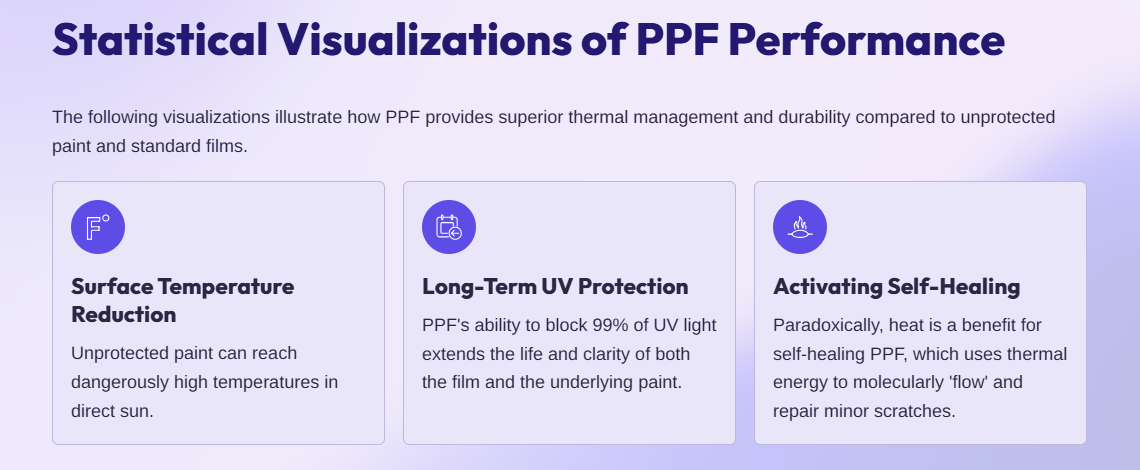
- High-quality PPF blocks up to 99% of harmful UV rays, significantly reducing yellowing and brittleness over time.
- Long-term UV exposure (2-5 years) causes polymer breakdown, leading to loss of flexibility and adhesive weakening (Dandrea Detail, 2024).
- Thermal Effects on PPF and Paint:
- Unprotected paint surface temperatures can exceed 180°F (82°C) in direct sunlight, accelerating oxidation and clear coat failure.
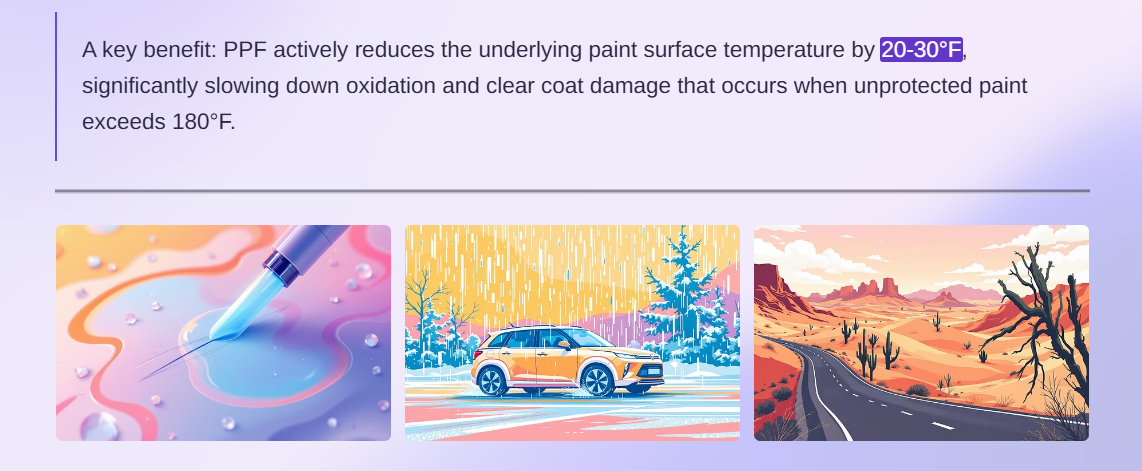
- PPF reduces surface temperature by 20-30°F, mitigating heat-induced paint damage (Kaloko Tinting, 2025).
- Durability Under Weather Extremes:
- Exposure to freeze-thaw cycles, road salt, and moisture can cause bubbling or peeling if PPF adhesive weakens.
- Self-healing PPF uses heat to repair minor scratches, leveraging temperature fluctuations as a benefit.
Visual Elements (suggested charts/graphics):
- Bar Chart: Max temperature tolerance of various PPF brands (e.g., STEK 200°F vs. general PPF 350°F limit).
- Line Graph: UV exposure duration (years) vs. PPF degradation level (yellowing, brittleness).
- Heat Map: Surface temperature comparison of unprotected paint vs. PPF-covered paint under direct sunlight.
- Infographic: PPF protective layers blocking UV rays and heat, showing self-healing mechanism triggered by heat.


Sources: Presidential Detailing (2024), Dandrea Detail (2024), STEK Autospa (2024), Forbes (2024), Kaloko Tinting (2025)
Paint protection film is more than a transparent layer; it’s a living example of materials science in motion. It expands, contracts, heals, and defends — all while maintaining the vehicle’s original beauty. From the heat of summer to the chill of winter, it adapts gracefully to the world around it.
At Capital Wrappers, exploring how PPF interacts with environmental factors reveals why understanding its science matters. It’s this balance of chemistry, durability, and adaptability that keeps vehicles looking their best year after year, regardless of climate or condition.
FAQs
How does paint protection film react to extreme temperature swings?
It stretches and contracts slightly with surface changes, maintaining full adhesion and preventing cracks or bubbles.
Can UV radiation cause paint protection film to degrade?
Not in modern films. They use UV stabilizers and HALS compounds that neutralize radiation and stop oxidation.
Does heat help PPF self-heal scratches?
Yes. Gentle heat activates polymer movement in the film’s top layer, smoothing out light surface marks naturally.
Why doesn’t PPF yellow over time?
High-end films include anti-yellowing agents that convert UV light into harmless energy, preventing discoloration.
Is paint protection film effective in freezing climates?
Absolutely. Its flexible polymers and plasticizers keep it elastic, so it resists cracking or peeling even in subzero weather.