How Long Does Vinyl Wrap Take to Fully Cure After Installation?
Curing is the process in which the wrap adhesive fully bonds to the paint. At the same time, the vinyl settles into every curve and panel gap.
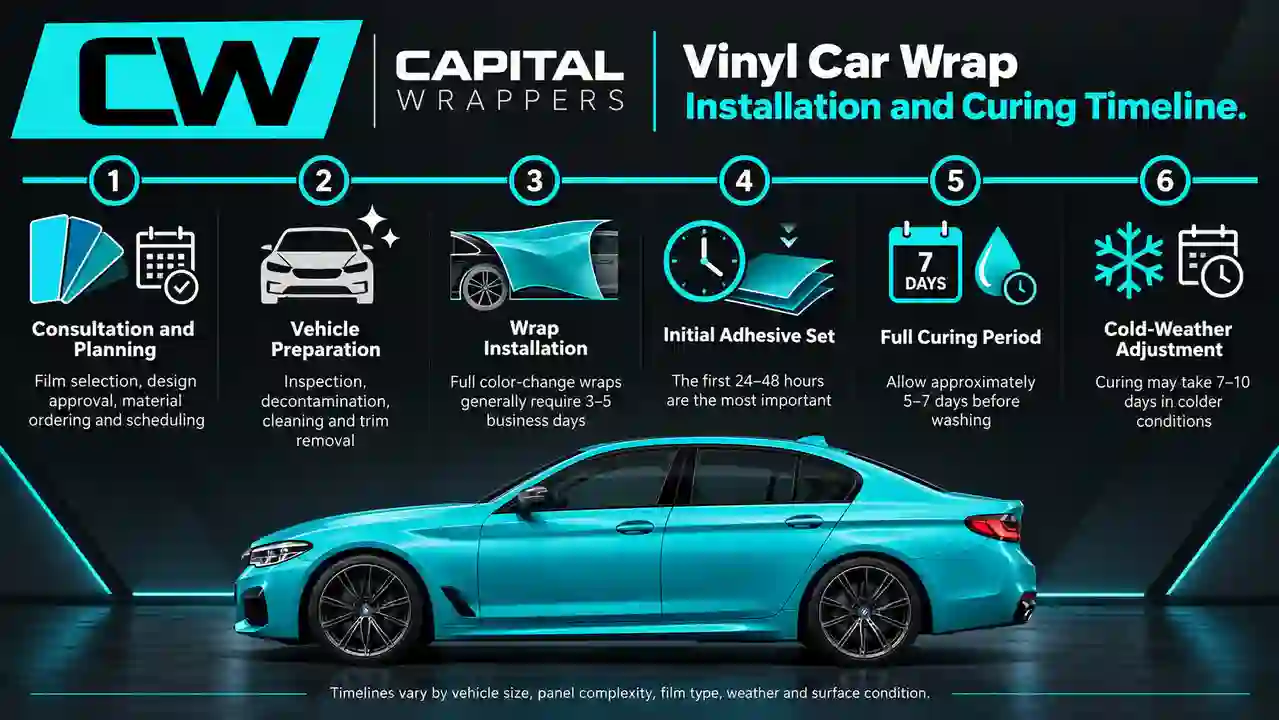
A full wrap needs 5 to 7 days to completely cure. The first 12 to 48 hours matter most. The adhesive is still hardening, and trapped air is still working its way out.
Initial Set vs Full Cure Timeline
Initial set happens fast. Edges and seams feel stable within 24 to 48 hours, and normal city driving is safe then.
Full cure takes longer, since the adhesive keeps strengthening for days after the vinyl looks finished. Treating the two milestones as the same thing is a common mistake.
A wrap that looks cured at 48 hours still needs the full 5- to 7-day window. Only then is it ready for a wash or highway speeds.
Cast Vinyl vs Calendared Vinyl Curing Speed
Cast vinyl is thinner and more conformable. It settles into curves faster and usually finishes curing within the standard 5- to 7-day range.
Calendared vinyl is thicker and more prone to shrinking. It can need closer to 7 to 10 days in cooler weather.
A closer look at cast vinyl and calendared vinyl wrap materials breaks down the difference. It also covers which one holds up better in Maryland’s climate over time.
What Happens During Professional Wrap Installation
A professional installation follows five stages: consultation, prep, application, curing, and final inspection. Skipping or rushing any stage is the top reason wraps cure poorly or fail early.
Prep work matters more than most owners expect. A vehicle needs a full decontamination wash, clay bar treatment, and paint inspection before any vinyl goes on. Dirt or wax trapped under the film prevents proper adhesion.
Capital Wrappers documents exactly how a vehicle is prepped before wrapping. The team then applies the wrap panel by panel, using heat guns to stretch the vinyl and squeegees to clear air pockets. A controlled, climate-regulated bay keeps the film at the right temperature throughout.
What Factors Affect Wrap Installation and Curing Time
Several variables change both the installation timeline and how long the vinyl takes to fully cure.
Vehicle Size and Surface Complexity
A compact sedan with mostly flat panels wraps faster than a truck or SUV. Wheel arches, mirrors, and body creases all add time.
Complex curves, including a curved roofline, need more heat stretching during install. That extra stretching extends the curing window, since more of the vinyl stays under tension.
Wrap Finish Type
Finish type changes both application speed and curing time. Textured finishes like chrome and satin need extra care during application, and typically add a day to the overall timeline.
|
Finish Type |
Added Time vs Standard Gloss |
|
Gloss or satin |
Baseline, no added time |
|
Matte |
Minimal, same-day install possible |
|
Chrome |
Plus 1 full day |
|
Color-shift or specialty |
Plus 1 to 2 days |
Choosing the right finish for a vehicle affects more than looks. It also affects how much extra install and cure time you need to plan for before booking a date.
Installer Experience and Quality
An experienced, factory-trained installer minimizes air pockets, wrinkles, and stretched seams during application. That precision directly shortens curing time.
Rushed or inexperienced work often traps air that has to work its way out slowly. That trapped air extends the visible cure well past a week.
How Rockville MD Weather Affects Wrap Curing Time
Temperature and humidity control how fast adhesive bonds and how much the vinyl expands or contracts while curing. The ideal curing range is 70 to 80°F with low to moderate humidity. Maryland sees those conditions reliably only in spring and fall.
Rockville summers regularly push into the high 80s and 90s with heavy humidity. That heat can cause vinyl to over-soften and shift slightly. This risk is highest if a vehicle sits in direct sun during the first 48 hours.
Shaded or garage parking during that window prevents most issues. Capital Wrappers covers how DMV weather affects a wrap over its full lifespan for owners planning installs around the seasons.
Winter presents the opposite problem, since cold vinyl becomes stiff and less adhesive. A wrap installed in freezing temperatures may need 7 to 10 days to cure. That is longer than the standard 5 to 7. Installing in a temperature-controlled bay avoids this swing, whether drop-off is in Rockville, Gaithersburg, or Potomac.
Planning a wrap around a Rockville summer or winter? Installs happen in a climate-controlled bay, so the curing timeline stays consistent regardless of the season outside. Call 301-417-5977 or visit the contact page to lock in a drop-off date and get a curing timeline specific to a vehicle’s size and finish.
Caring for a Freshly Wrapped Vehicle During the Curing Period
The curing period is when a wrap is most vulnerable to damage. A short list of dos and don’ts protects the investment during those first critical days.
Dos and Don’ts Right After Installation
Do:
- Park in a shaded or covered spot for the first 48 hours
- Inspect edges and seams gently for any lifting and report it early
- Keep the vehicle at normal city speeds for the first two days
Don’t:
- Wash the vehicle, by hand or automatic, for at least 5 to 7 days
- Use a heat gun or DIY fix on any lifted edge
- Park under trees or near sprinklers where sap or hard water can sit on fresh vinyl
When Can You Wash a Newly Wrapped Car? The 5 to 7 Day Rule
Washing a wrap before it fully cures is the fastest way to shorten its lifespan. Water pressure and detergent chemicals can lift edges that have not finished bonding. This can happen even if the wrap looks finished.
Once the 5 to 7 day window passes, hand washing is safest going forward. Use a pH-neutral, wrap-safe shampoo every time.
Avoid automatic car washes with brushes permanently. The friction wears down vinyl edges faster than hand washing ever will.
Signs Your Car Wrap Has Fully Cured
Three signs confirm a wrap has finished curing. Look for firm edges with zero lifting, a smooth surface with no bubbles, and consistent color across every panel. Checking these points before the first wash protects a wrap that needs a few more days.
Small bubbles that shrink and disappear over the first few days are normal outgassing, not a defect. Bubbles that grow larger, or edges that lift at the same spot repeatedly, usually point to an installation issue instead.
A breakdown of the most common causes of wrap bubbles and lifting helps owners spot the difference. That way, a quick call catches a real fix instead of a false alarm.
Does a Faster Turnaround Cost More? Rush Jobs and Scheduling
Same-day and rush turnarounds work for partial wraps and small accent projects. A full color-change wrap cannot safely be rushed below its 3 to 5 day install window. Doing so risks a poor cure.
Shops that promise a same-day full wrap are usually skipping prep steps that matter. Rush scheduling can also add a premium, since it often means reordering material or pulling installers off other projects.
Current color-change wrap pricing in Maryland runs from roughly $2,500 for a standard sedan. Rush fees typically add to that base rate rather than replacing it.
Typical Turnaround Time by Wrap and Vehicle Type
Turnaround varies by vehicle size and by how much of it gets wrapped. The table below gives realistic ranges for planning.
|
Wrap Type |
Install Time |
Full Cure Time |
|
Partial wrap or accents |
4 to 8 hours |
24 to 48 hours |
|
Full wrap, sedan |
2 to 3 business days |
5 to 7 days |
|
Full wrap, SUV or truck |
3 to 4 business days |
5 to 7 days |
|
Commercial fleet vehicle |
2 to 4 business days per vehicle |
5 to 7 days |
Fleet and commercial jobs often run in batches, so a multi-vehicle order needs a longer overall project window. Each individual vehicle still follows the same cure timeline. Commercial fleet scheduling scales around a business’s operating needs, so vehicles rotate back into service with minimal downtime.
Protecting Your Wrap Investment After It Cures
Once curing finishes, ongoing care determines how long the wrap actually lasts. Hand washing with wrap-safe products keeps the finish intact. A ceramic or polymer sealant applied every 3 to 6 months adds another layer of protection.
Checking edges periodically for early lifting catches small problems before they spread. Most manufacturer and installer warranties require proof that curing guidelines were followed.
Skipping the wait before a first wash can affect coverage down the line. Understanding what a wrap warranty actually covers before an install helps owners avoid voiding protection over an avoidable mistake.
Why Premium Film Brands Matter for a Reliable Cure
Not all vinyl cures the same way. Films from 3M, Avery Dennison, PWF, and Inozetek use adhesive formulations built for predictable, even curing across a full vehicle.
Budget or off-brand vinyl often skips those same quality controls. That shortcut shows up as uneven curing, premature shrinking, or adhesive failure at the edges within the first year.
The 3M Wrap Film Series 2080 product information outlines the technical standards premium manufacturers build to. It is a useful reference point when comparing shops on material quality rather than price alone.
Common Myths About Car Wrap Curing Time
A few persistent myths lead owners to damage a wrap before it has finished setting.
Myth: Curing does not matter once the wrap looks finished. False. The adhesive keeps bonding for days after the surface looks smooth, and interrupting that process early causes lifting later.
Myth: A wrap is safe to wash the day after install. False. Even a light wash within the first 48 hours can lift edges that have not fully bonded yet.
Myth: Hot weather speeds up curing safely. False. Uncontrolled heat causes the vinyl to over-stretch and shrink unevenly instead of curing faster in a useful way.
Myth: Every vinyl brand cures on the same schedule. False. Film thickness and adhesive formulation both change the timeline, and premium brands tend to cure more predictably than budget alternatives.
Final Thoughts on Car Wrap Curing Time
A full wrap install runs 3 to 5 business days. The vinyl then needs 5 to 7 more days to fully cure. Only then can it handle a wash or hard driving.
Booking with a shop that controls the environment during both install and curing protects the finish from day one. Capital Wrappers builds every project around this timeline. A deeper look at how long a vehicle wrap really lasts shows why the wait pays off.
Ready for an exact timeline for your vehicle? Capital Wrappers walks Rockville drivers through the full install and curing schedule, with no surprises about drop-off or pickup dates. Call 301-417-5977 or reach out through the contact page to book a consultation.
Frequently Asked Questions
How long does it take for vinyl wrap to cure after installation?
Most full wraps need 5 to 7 days to fully cure. The first 24 to 48 hours matter most, since the adhesive is still bonding and trapped air is still releasing. Cold Rockville winters can push a full cure closer to 10 days. Keeping the vehicle out of direct sun helps it cure evenly.
How long does it take to wrap a car from start to finish?
A full color-change wrap takes 3 to 5 business days to install. Curing then adds another 5 to 7 days. Total time from booking to pickup runs 1 to 3 weeks for most Rockville drivers. Booking during a slower season usually shortens the wait for an open drop-off slot.
What is the turnaround time for getting a car wrap done?
Turnaround runs 1 to 3 weeks from first consultation to a fully cured finish. In-shop install time is 2 to 4 business days for most sedans. Scheduling and vehicle prep usually make up the rest of that wait. Rush turnarounds work for partial wraps, but not for full color-change projects.
How long do I have to wait to wash my car after a vinyl wrap?
Wait at least 5 to 7 days before the first wash. Washing sooner risks lifting edges that haven’t fully bonded, even if the wrap looks fully set. Hand wash only afterward, using a pH-neutral, wrap-safe shampoo. Avoid automatic car washes permanently after that.
Does cold or hot weather affect how long a car wrap takes to cure?
Yes. Cold weather can extend curing to 7 to 10 days, since stiff vinyl bonds slower. Uncontrolled summer heat causes uneven stretching instead of a genuinely faster cure. Rockville summers and winters both call for indoor, climate-controlled installation and curing space year-round.
Can I get a car wrap done same day or with rush turnaround?
Small partial wraps or accents can often be done same day. Full color-change wraps generally cannot be rushed below 3 to 5 business days. Rushing past that point risks a poor, uneven cure. Shops promising a rushed full wrap usually skip the prep steps that matter most in the long run.