How Window Tinting Affects Interior Temperature and Comfort Levels
Have you ever opened your car door on a hot summer day and felt like you just walked into an oven? That’s not an exaggeration—it’s science at work. Cars absorb and trap heat fast, making interiors uncomfortable and even unsafe at times. This is where window tinting comes into play.
But how exactly does tinting help with temperature control and overall comfort? Let’s break it down step by step.
Why Interior Temperature Matters More Than You Think
The inside of your car isn’t just a place to sit while you drive—it’s your mini living room on wheels. Comfort matters more than we realize.
The Hidden Impact of Heat on Drivers and Passengers
When your car interior feels like a sauna, it doesn’t just cause discomfort. Heat affects mood, concentration, and alertness. A driver who’s sweating and irritated is more likely to make mistakes on the road.
How Excess Heat Damages Vehicle Interiors
High temperatures don’t just impact people. Upholstery fades, dashboards crack, and electronics suffer under constant exposure to heat. The damage builds up over time, silently cutting down the life of your car’s interior.
The Science of Heat Transfer Through Glass
Glass may look solid, but when it comes to sunlight, it’s more like an open door.
How Sunlight Enters a Car
Sunlight carries visible light, infrared rays, and ultraviolet (UV) rays. Regular car windows block some UV but let most infrared heat inside.
The Greenhouse Effect Inside Vehicles
Once sunlight passes through the glass, it’s absorbed by surfaces inside the car. That energy is then released as heat, but it can’t escape through the glass efficiently. The result? Temperatures that can soar 30–40 degrees higher than outside.
What Window Tinting Does to Control Heat
So where does window tinting fit in? Think of it as sunglasses for your car—only smarter.
Light Transmission and Heat Rejection Explained
Tinting films filter sunlight, reducing how much heat enters the car. The percentage of “visible light transmission” (VLT) determines how much light passes through the film. Lower VLT means less light and less heat.
Infrared Blocking Technology in Modern Films
Modern films don’t just darken glass. Advanced versions block a huge portion of infrared rays—the main culprits behind heat buildup.
Ceramic Window Tinting and Its Role
Ceramic films stand out because they block up to 99% of UV rays and significant infrared heat, all without interfering with visibility. They’re the gold standard when comfort and temperature control are top priorities.
Real-World Scenarios Where Window Tinting Improves Comfort
This isn’t just theory—it’s something you feel in daily life.
Short City Drives vs. Long Highway Trips
Even a ten-minute city drive can feel unbearable without tinting. On highways, the longer exposure to sun makes tinting even more crucial.
Sitting in Traffic Under Direct Sunlight
Few things are worse than being stuck in bumper-to-bumper traffic while the sun beats down. Tinting softens the blow by cutting glare and heat.
Family Travel and Keeping Children Comfortable
Kids are especially sensitive to heat. Window tinting ensures backseat passengers aren’t left sweating during family trips.
How Window Tinting Reduces Strain on Vehicle Cooling Systems
When your car is cooler to begin with, your AC doesn’t have to fight as hard.
Less Dependence on Air Conditioning
A cooler cabin means you can set the AC lower or use it less often. That’s easier on your system and helps maintain performance long-term.
Fuel Efficiency and Energy Savings
In cars, heavy AC use burns fuel. In electric vehicles, it drains the battery. Tinting indirectly saves energy by reducing AC demand.
Window Tinting and Seasonal Comfort
Window Tinting Rockville isn’t just for scorching summers—it works year-round.
Summer Heat Control
Tinting keeps the car cooler, so you don’t burn your hands on the steering wheel or leather seats.
Winter Insulation Benefits
High-quality films also help retain warmth inside the cabin during cold months, making rides more comfortable.
Comparing Different Tinting Films for Temperature Regulation
Not all films deliver the same level of comfort.
Dyed Films and Their Limitations
Affordable but less effective at blocking heat. They focus more on reducing glare.
Metalized Films and Heat Reflection
Better at reflecting heat but can interfere with cell and GPS signals.
Carbon Films and Interior Comfort
Great for UV and heat rejection with no signal issues. They also prevent fading inside the vehicle.
Ceramic Films as the Premium Choice
The best option for comfort and heat control. They reject both UV and infrared rays without affecting visibility.
The Psychological Side of Comfort in Cooler Interiors
Cooler interiors don’t just make you feel better—they affect how you drive.
Reduced Irritability and Fatigue While Driving
Ever noticed how frustration builds faster in a hot car? Tinting helps keep tempers—and temperatures—low.
Sharper Focus and Alertness on the Road
Comfortable conditions mean fewer distractions and more attention on driving safely.
Myths About Window Tinting and Interior Comfort
Let’s clear up some common misunderstandings.
Myth: Darker Tint Always Means Cooler Cars
False. Darkness isn’t the same as heat rejection. Quality films, even lighter ones, can block more heat than basic dark tint.
Myth: Window Tinting Is Only for Style and Privacy
Also false. While tinting does improve privacy, its role in comfort and temperature control is far more significant.
Health Benefits of a Cooler Vehicle Interior
Your body benefits just as much as your car.
Lower Risks of Dehydration and Heat Exhaustion
High cabin temperatures can quickly dehydrate you. Tinting keeps interiors safer, especially for kids and elderly passengers.
Protecting Skin From Prolonged Heat Exposure
Beyond UV rays, constant exposure to high heat can stress your skin. Cooler conditions help maintain skin health.
Capital Wrappers Serving the New Mark Commons Community and Beyond in Rockville
Capital Wrappers is dedicated to serving the diverse needs of the local community of Rockville, including individuals residing in neighbourhoods like New Mark Commons. With its convenient location near landmarks such as the Monument Park, Dogwood Park and major intersections like Wootton Pkwy & Rockville Pike and Blandford St & Mt Vernon Pl (coordinates: 39.070801808126944, -77.14749884293403, we offer window tinting
Get window tinting Services at New Mark Commons Now
Navigate from New Mark Commons to Capital Wrappers Now
How Window Tinting Affects Interior Temperature and Comfort Levels
- Interior Temperature Reduction:
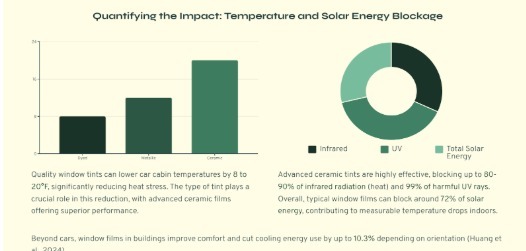
- Quality window tint can lower car cabin temperatures by 8 to 20°F (4.4 to 11.1°C), significantly reducing heat stress inside vehicles (Extreme Car Audio LLC, 2025).
- In buildings, heat-absorbing and reflective window films reduce indoor temperatures and improve comfort, with reflective films cutting cooling energy use by up to 10.3% depending on orientation (Huang et al., MDPI, 2024).
- Solar Energy Blocked:
- Advanced ceramic tint block up to 80–90% of infrared radiation, the main cause of heat buildup, while also filtering up to 99% of harmful UV rays (5Star Auto Detail, 2024).
- Typical window films can block around 72% of solar energy, leading to measurable temperature drops indoors (Ratchet Werks experiment).
- Comfort & Energy Efficiency Benefits:
- Reduced interior heat means less reliance on air conditioning, lowering energy consumption and extending electric vehicle battery range (Solar Shade Window Tint, 2025).
- Glare reduction from tinting improves visual comfort and safety during bright conditions.
Visual Chart Concepts (to be designed):
- Bar Chart:
- X-axis: Tint Type (Dyed, Metallic, Ceramic)
- Y-axis: Interior Temperature Reduction (°F)
- Bars showing 8°F (Dyed), 12°F (Metallic), 20°F (Ceramic)
- Pie Chart:
- Percentage of Solar Energy Blocked by Tint:
- Infrared: 80%
- UV: 99%
- Visible Light: varies by tint
- Percentage of Solar Energy Blocked by Tint:
- Line Graph:
- Indoor Temperature Over Time (with vs without tint) showing up to 1°F drop in a room experiment (Ratchet Werks).
Sources:
- Extreme Car Audio LLC, “Window Tint Cooling Effect,” July 2025
- Huang et al., “Evaluation of the Effects of Window Films on the Indoor Environment,” MDPI Energies, March 2024
- 5Star Auto Detail, “How Do Scientists Measure Heat Rejection in Window Tint?” Nov 2024
- Ratchet Werks, “How much does window tinting cool down a room,” 2025
- Solar Shade Window Tint, “The Impact of Window Tint on Your Tesla’s Energy Efficiency,” April 2025 )
FAQs
Does window tinting keep a car cool without air conditioning
Not entirely, but it significantly reduces heat buildup, making the cabin cooler even before you turn on the AC.
Can window tinting help in winter too?
Yes. Quality films provide insulation, keeping warmth inside the car during colder months.
Which type of film is best for controlling heat?
Ceramic films are widely regarded as the most effective for blocking infrared heat and UV rays.
Is a darker tint always better for comfort?
No. Performance depends on film technology, not just shade. Even lighter ceramic films can outperform darker dyed ones.
How does window tinting affect fuel efficiency?
By reducing reliance on air conditioning, tinting helps conserve fuel or battery power, improving overall efficiency.